Categories
Life Toronto

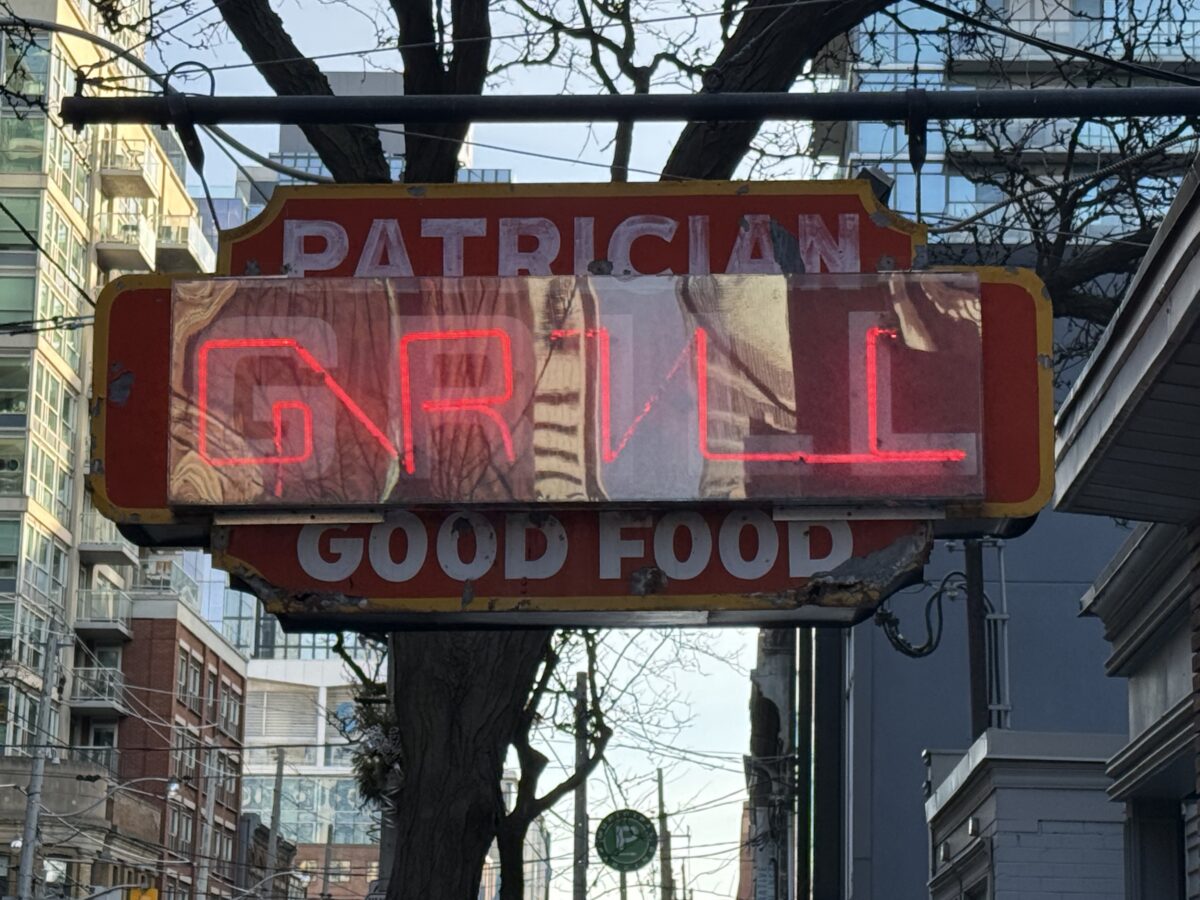
The Patrician

People take wonders for granted. Growing up on the east coast, I took the ocean for granted. Visitors would gush about its awesome power each summer I worked the tourist bureau in Halifax, but for locals it was just the ocean and was always going to be there. When I moved to Calgary, the mountains took my breath away. Calgarians appreciated them, but seemed ambivalent. While I would catch myself stopping to stare from my perch on the 20th floor of the NOVA Gas Tower, the long-term residents of Cowtown went on with their lives. We become ambivalent to the sublime the longer we’re exposed to it.

Wonders come in all shapes and sizes. The big ones are breathtaking and inspiring, but the little ones are the building blocks of our lives. The tragic difference is the little ones have a bad habit of disappearing.

The Patrician Grill’s been around since the 1950s. In downtown Toronto, that’s an eternity. This city loves tearing down the old to throw up the new. Along the way, it’s developed the bad habit of gutting heritage buildings, booting out the original inhabitants and tacking the facade onto 50 stories of condo, like some kind of awkward exercise in architectural taxidermy. Real estate is expensive in this place, no matter what kind of downturn we might be in, so the sacrifice of older buildings and businesses to feed the condo beast isn’t stopping anytime soon.

The Patrician defies that destiny: it’s a single-story diner slowly getting crowded out by condo after condo. It’s like a bantam fighter that resolutely wakes up every morning to duke it out with the heavyweights, and somehow, incredibly, keeps coming up with a draw. It’s nothing short of a minor miracle that anything that small can endure in the heart of a city determined to become Manhattan North.

I’ve lived in the neighbourhood for 12 years and seen a slew of businesses rise and fall. Some of them are headscratchers. Did the owners of that coffee shop not do their research? There’s nowhere near enough foot traffic to sustain them. How is that restaurant going to survive on that corner with those kind of prices? A florist on that street — really? I’m slightly ashamed to admit it, but I run a dead pool in my head each time a new place opens, knowing the neighbourhood far better than so many unfortunate owners with big dreams and inadequate business plans.

That’s why a diner that’s only open for breakfast and lunch six days a week is flabbergasting. But somehow I took it for granted as it faded into the background each day I walked by. The place had changed hands from the original owner to a new one, to the new one’s kids and would (I assumed) be handed down to their kids.

Until one day it wasn’t.

After seventy-some years, the Patrician was closing. Locals were legitimately shocked: it had survived till 2026 and gave every impression of surviving further. I realized having a place like that show up on the street every day and inject a little colour, a little anachronism, a little originality into a city whose unofficial colour is medium grey, lifted my soul just a touch. A tinge of guilt followed: I had never been in, not even for a coffee. I made sure to remedy the situation.

A sign outside proudly proclaims, “In this neighbourhood you can pay $5 for an Italian coffee or $2.25 for a coffee served by a guy who kinda looks Italian.” The inside isn’t overloaded with mementos the way I had imagined. There’s art on the walls, actual paintings, not prefab neon kitsch and dogs playing poker. A jazz station plays over the speakers. Locals start to drift in, mostly older folk, and the staff reliably recite their orders before they’ve even uttered a word. The people behind the counter are busy but relaxed, and seem to genuinely enjoy themselves, with the kind of banter I’d expect from a Hollywood version of a corner diner: the Leafs, the weather and everything in between.

It’s easy to wax nostalgic about places like this and hold onto them for dear life. I find myself falling into this habit the older I get. That’s why it’s important to recognize the small wonders life has to offer and embrace them while you can: they’re the difference between an indifferent, anonymous world and one with sparks of life and originality that make it worth enjoying.

I demolish an omelette and cup of coffee in short order, get to the cash register and feel my heart sink: cash only. Part of me scolds myself for not realizing a place like this operates on tight margins and wouldn’t accept credit cards. Part of me wants to shout “Buddy, did you not get the memo that it’s 2026?!” Luckily, I keep $20 in a pocket on the back of my phone for emergencies and manage to cover the bill, but with next to nothing for a tip. “Don’t worry about it; you’ll be back, right?” the co-owner asks.

I guess so. Like so many of the faithful, I’ll be back to experience a small wonder while I still can.
Categories
Thoughts Toronto Uncategorised

The Hill

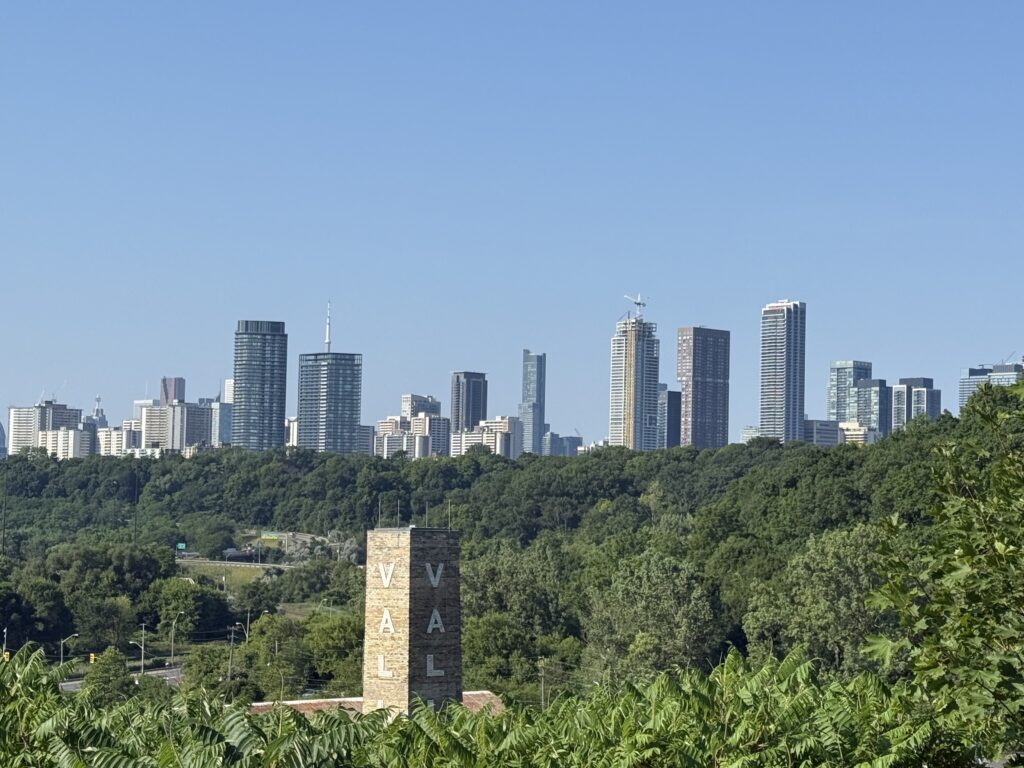
A view of downtown Toronto from the top of the Don Valley Brickworks
The Hill itself

In my mind it looms large. In reality it’s little more than a path leading out of a Toronto park, a former quarry. Generations scooped out shale and clay for the bricks that built old town Toronto. After that ran out, the local conservation authority bought the land and turned it into a park. Now tourists, wedding parties and cyclists saunter leisurely through the landscaped pit, admiring the ponds where steam shovels formerly ripped the earth

I don’t saunter. I pit myself against “The Hill” as I call the path. It’s my own Tour de France mountain stage, a personal biking challenge, even though it’s only about 80 feet high.

If no one’s lollygagging at the base, I can gather speed and let momentum carry me partway up. That never lasts long before I need to start pumping the pedals. It wouldn’t be difficult if it didn’t snake up and around on its way to the top. It’s those damn turns that make it challenging.

A hot day makes it even tougher, as my lungs labour to compress the sticky soup Toronto calls summer air. Even without the added difficulty, there’s a point where doubt starts creeping in: am I going to make it?

That sounds terribly dramatic but is entirely self-inflicted. Not making it means walking the rest of the way, not falling to my doom. There are no medals for reaching the top, except the one in my mind that says “Not today, Hill. I win.”

But a few years ago, the realization hit me: one day The Hill is going to win, finally and forever. Over the last few years, I’ve had to admit defeat and perform my self-inflicted walk of shame more often than I care to admit. Those times seem to be coming more frequently, even though I’m still in my early 50s. At moments like those I think about my dad.

He passed away last summer, but in his final years he was able to do fewer and fewer things that were dear to him. First he had to give up his house and move to a seniors facility. Then he had to stop driving. Then the long walks stopped, and eventually walking anywhere aside from the dining hall ceased. But the loss I remember most is fishing. For years, I tried to go fishing with him one last time, like we did when I was a little boy. I could see the day coming when we wouldn’t be able to do so ever again. I tried convincing him again and again to let me drive him down to St. Margaret’s Bay outside Halifax, where we used to cast for mackerel.

But there always seemed to be a reason not to go until one day age won, and I realized we were never going to go fishing together again. I think about that whenever I catch myself crafting an excuse not to do something I enjoy, or when I feel like giving up before the finish. The little victories I earn atop The Hill makes me feel alive in some small way, and I try to remind myself that one day the choice to try again won’t be there.

That’s what I tell myself whenever I’m feeling the burn going up The Hill. Near the top there’s sometimes a panic moment when I start to wonder, breath labouring, “What happens if I pass out? Has anyone had a coronary trying to summit this thing?” It’s pretty silly, and is more about anxiety than imminent system collapse. I realize it’s not the Pyrenees and I’m not in the Tour de France. But when I’m pedalling like crazy and starting to doubt myself, my mind can spiral away in strange directions.

The reward is a view of the Don Valley, a lush canopy struggling to eclipse the taller and taller towers Toronto is continually pushing up downtown.

One day will be the last victory. I won’t know which one it is. It’ll just be a good day before a not-so-good day. But then the next day will be another not-so-good day, and another, until I finally realize The Hill has won.

This is the way of all flesh: the things that were easy a few years, a few decades ago, one day seem hard.

Age is a process, not an event. It’s a companion you develop a closer relationship with the longer you last, a kind of friend you grow closer to. Age gradually takes things away, some good and some bad. It takes away selfishness, immaturity and impulsiveness. It also takes away strength and reflexes. I didn’t say it was always a kind friend, but it’s the only lifelong friend you’ll ever have.

Maybe I’ll get a better bike, a real racer, that will buy a few more years of victories and delay the inevitable. That day will come, but not quite yet. For now, in man vs. Hill, I’m still coming out on top more often than not.

Categories
Life Thoughts Toronto

Accidentally Torontonian

It was only supposed to be a year: move to Toronto, get the certificate, move back to Calgary and continue with life.

23 years later, the move back to Calgary hasn’t happened. I have become, accidentally, Torontonian.

That was never the plan. I never had any desire to move to the Big Smoke.
Growing up on the east coast, Toronto seemed incredibly distant, a mysterious chunk of population somewhere past Montreal where folks moved later in life, and from where repairmen ordered parts for your fridge.

Later, it gained an unfortunate reputation as a breeding ground for snobbery. I remember the handful of kids transplanted from Toronto. Young and naive, many of them assumed us yokels would be awed by their big city pedigree, and flaunted it accordingly. That was a bad idea that backfired consistently, leading to ostracism and the conclusion that TO was a jerk factory.

After finishing school, I was faced with a decision: Halifax’s economy was small and sputtering, and I felt the need to move somewhere with more opportunities. Toronto’s economy was in the dumps, Vancouver was too expensive, I’d already lived in Ottawa, and I didn’t think my French was good enough for Montreal. Calgary beckoned with an oil economy firing on all cylinders, and I made the leap.

Soon after landing, I discovered something Calgarians share with Haligonians: antipathy for Toronto. The more folks I met, the more I realized those feelings of resentment travel across our great land. In fact, the unifying force in our country isn’t the great outdoors, maple syrup, poutine or even hockey: it’s animosity for Toronto.

Some of that has nothing to do with the town itself. It’s probably aimed at residents of every big city around the world, from Beijing to Buenos Aires. I think it stems from the inhabitants’ sense that they’re from somewhere just a little more sophisticated, important or awesome than anywhere else. I breathed that in when I landed in Hogtown in 2000.

I loved Calgary. I had no intention of leaving, until I hit a ceiling at work and needed a diploma to keep moving up. I found a program at Humber College, packed everything in boxes and bought a one-way ticket, confident I’d return in a year.

Toronto didn’t impress at first: it felt too big, impersonal and uncaring. It seemed less like a city with an identity or personality, and more like a sea of people crammed together on top of each other.

That feeling started to change when I moved to a friendlier neighbourhood, and found parks and shops I liked, a favourite pub and a go-to coffee shop. I started to discover what there was to like about this big fat city. There were neighbourhoods branded everything from “Little Italy” to “Little Tibet”. There were festivals and a theatre scene I stumbled into after an acting class. There were the bucket list concerts I finally got to see, museums, restaurants and all the other things tourist bureaus stuff into ads.

I ended up staying another year. I found a job and then a girlfriend. I got another apartment. I found another job and another girlfriend. I kept discovering more things to like about the city: bike trails, the islands, ravine hikes and more.

Years passed with the plan to move back to Calgary quietly receding in the rear-view mirror but never overtly abandoned. And then something quite unexpected happened: I started becoming Torontonian.

I’ve transformed, and I doubt the me from 23 years ago would recognize the current one. I’ve become that guy, the infinitely impatient one muttering under their breath at people lollygagging on the sidewalk when they’ve got places to be right now. (Could you walk any slower, buddy?) I talk about how the vibe in places like Kensington Market needs to be protected from gentrification, as if “vibe” were something that shows up on Google Maps. I read blogs and magazines about the city as often as I read ones about Canada itself. And I’ve embraced the idea that there’s something impressive about living in the biggest city in the land.

Recently I had to confront just how Torontonian I’ve become. Part of me will always hate myself for admitting it, but one night in front of the TV — how can I really be saying this?

I found myself cheering for the Leafs.

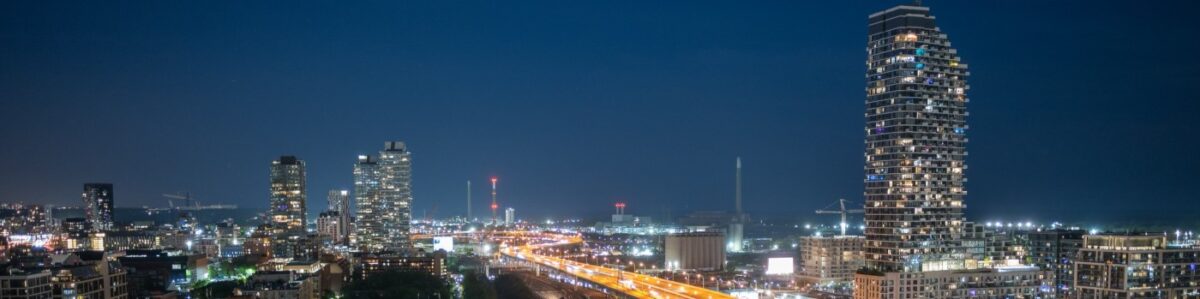
You can’t spend 23 years somewhere and not have it change you. Halifax will always be home, because home is where the heart is. But home is also where you hang your hat, and that’s Toronto. It’s where my condo leers over the perennially pissed-off drivers on the Gardiner Expressway. It’s where my cats constantly fight and make up. It’s where I found my wife, and where all but a few friends live. It’s the city that needs constant reassurance, but which is somehow quietly certain it’s the Centre of the Universe.

That’s what makes a good city great: a balance of contradictions.
A friend had a theory that life sorts you into the city in which you truly belong, by size, temperament and so on. Calgary is young and a little conservative. Ottawa is bureaucratic, well-planned and restrained. Halifax is friendly and loves a good time.

And Toronto? Well, Toronto is never satisfied. It obsesses about its shortcomings, even as it lands near the top of “best cities in the world” lists, a pessimism born from privilege. Toronto is the commercial, financial and cultural centre of the country even as it dreams of becoming New York City when it grows up. It’s the centre of its universe, but also the centre of self-doubt, perpetually comparing itself to everywhere around it.

That describes me a little: a collection of contradictions. It’s what endears me to the city. Like me, Toronto doesn’t have just one identity. At a certain point a city becomes too big for that, and its identity becomes the sum of its parts. Or maybe that’s way too Zen and Toronto is just like every other big city, with its good, bad, beauty, ugliness and endless complexity.

By my calculation, sometime in 2025 I’ll have spent more than half my life here. Assuming I last long enough, will I retire and end my days here? Will I move back “home” to Halifax? Maybe I’ll go back to Calgary. Maybe I’ll find a villa in Italy. Who knows? But this town has shaped me as surely as any other has.

I have become, unexpectedly, Torontonian.